Chakras and Their Significance | Srf | Vibepedia.Network
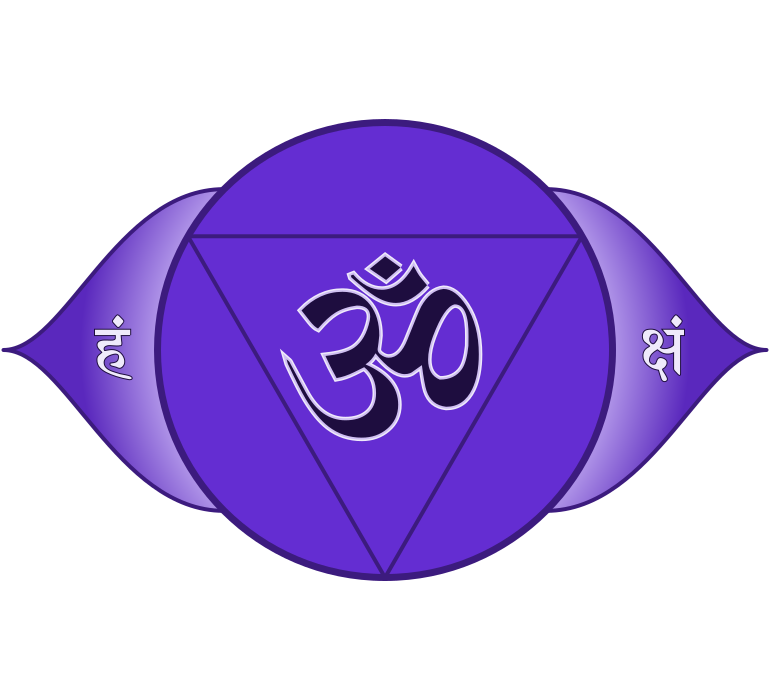
The concept of chakras, meaning 'wheels' or 'vortices' in Sanskrit, has ancient roots in India, tracing back to Vedic texts and later elaborated in yogic and…
Contents
Overview
The concept of chakras, meaning 'wheels' or 'vortices' in Sanskrit, has ancient roots in India, tracing back to Vedic texts and later elaborated in yogic and tantric traditions. These energetic centers are crucial for spiritual awakening and self-realization. Each chakra is associated with specific physical, emotional, and spiritual functions. Awakening and balancing chakras are central to achieving higher states of consciousness, overcoming blockages, and realizing one's divine potential. The journey through the chakras, from the grounding Muladhara at the base of the spine to the transcendent Sahasrara at the crown of the head, is a profound exploration of the self, guiding practitioners toward inner harmony and union with the Infinite.
🎵 Origins & History
The concept of chakras, meaning 'wheels' or 'vortices' in Sanskrit, has ancient roots in India, tracing back to Vedic texts and later elaborated in yogic and tantric traditions. Early mentions of chakras appear in texts like the Upanishads, though the detailed mapping of the seven primary chakras was significantly developed in medieval tantric literature. The Sat-Cakra-Nirupana is a tantric text that elaborated on chakras. Teachings on chakras were later introduced to the West, notably by figures like Paramahansa Yogananda, who integrated them into his teachings on Kriya Yoga and Self-Realization Fellowship, emphasizing their role in the ascent of consciousness through the spinal cord.
⚙️ How It Works
Chakras function as conduits and regulators of prana, the vital life force energy that animates all beings. Each of the seven primary chakras is situated along the Sushumna nadi, the central energetic channel within the spine, and is associated with specific plexuses of nerves and endocrine glands in the physical body. For instance, the Muladhara (Root Chakra) at the base of the spine governs our sense of security and grounding, while the Ajna (Third Eye Chakra) in the forehead is linked to intuition and inner wisdom. When prana flows freely through balanced chakras, individuals experience physical vitality, emotional equilibrium, and mental clarity. Blockages or imbalances in these centers can manifest as physical ailments, emotional distress, or spiritual stagnation, hindering the path to self-realization.
📊 Key Facts & Numbers
There are seven primary chakras, each with a distinct color, Sanskrit name, and vibrational frequency: Muladhara (Red), Svadhisthana (Orange), Manipura (Yellow), Anahata (Green), Vishuddha (Blue), Ajna (Indigo), and Sahasrara (Violet/White). The entire system is designed to facilitate the upward movement of Kundalini energy, a potent spiritual force said to reside at the base of the spine, which, when awakened, ascends through these chakras. It's estimated that over 80% of individuals seeking spiritual growth engage with chakra practices, with global interest in yoga and meditation, which often incorporate chakra work, growing by an average of 10-15% annually. The concept of prana flowing through these energetic pathways is central to yogic physiology, influencing over 72,000 nadis (energy channels) within the body.
👥 Key People & Organizations
Paramahansa Yogananda, author of "Autobiography of a Yogi," is a pivotal figure in popularizing the understanding of chakras within the Western spiritual landscape, particularly through his Self-Realization Fellowship (SRF). He detailed the energetic and psychological significance of each chakra, linking their states to the evolution of consciousness. Other influential figures include Swami Satyananda Saraswati, who extensively documented chakra practices in "Kundalini Tantra," and Sir John Woodroffe (Arthur Avalon), whose early 20th-century translations and interpretations of tantric texts like "The Serpent Power" brought these concepts to a wider academic and spiritual audience. Organizations like SRF and Bihar School of Yoga continue to be primary centers for teaching and preserving these ancient teachings.
🌍 Cultural Impact & Influence
The concept of chakras has permeated global wellness culture, influencing practices ranging from yoga and meditation to energy healing modalities and even artistic expression. The visual language of chakras—their colors, symbols, and associated deities—has become widely recognized, appearing in everything from spiritual retreats to mainstream media. This widespread adoption has led to a broader appreciation for subtle energy systems and their potential impact on well-being, though it has also led to a dilution and commercialization of the original teachings. The influence extends to therapeutic approaches, where practitioners use chakra balancing techniques to address physical and emotional imbalances, reflecting a growing interest in mind-body-spirit interconnectedness.
⚡ Current State & Latest Developments
In contemporary spiritual circles, the understanding and application of chakra knowledge continue to evolve. Modern interpretations often focus on practical techniques for balancing and activating these centers through meditation, breathwork (pranayama), affirmations, and visualization, as taught by contemporary yoga masters and spiritual teachers. There's a growing emphasis on integrating chakra work with psychological well-being, viewing them as maps for understanding and healing emotional patterns. Advances in biofeedback and subtle energy research are also beginning to explore the physiological correlates of chakra states, though these remain largely within the realm of complementary and alternative medicine, distinct from mainstream scientific consensus.
🤔 Controversies & Debates
One of the primary debates surrounding chakras concerns their scientific validity. While proponents point to anecdotal evidence and the subjective experiences of practitioners, mainstream science has yet to provide empirical proof for the existence of chakras as distinct energetic structures. Critics often categorize chakra concepts as metaphorical or symbolic representations of psychological states rather than literal anatomical or energetic entities. Furthermore, the commercialization of chakra-related products and practices has led to concerns about misrepresentation and the potential for exploitation, with some arguing that the depth of the original teachings is often lost in translation for mass consumption.
🔮 Future Outlook & Predictions
The future of chakra understanding likely lies in a more integrated approach, bridging ancient wisdom with modern scientific inquiry. As research into consciousness, subtle energies, and the mind-body connection advances, we may see more robust frameworks for understanding the physiological and psychological effects of chakra practices. There's also a potential for greater cross-cultural dialogue, as different traditions explore their own energetic systems and find common ground with the chakra model. The challenge will be to maintain the integrity and profound spiritual purpose of these teachings amidst increasing global interest and commercial pressures, ensuring they continue to serve as genuine pathways to self-realization.
💡 Practical Applications
Chakra knowledge offers a rich toolkit for personal growth and spiritual development. Practices such as guided meditation focusing on each chakra, chanting specific mantras (like 'LAM' for Muladhara or 'HAM' for Vishuddha), and utilizing color therapy or aromatherapy are widely employed. For instance, individuals experiencing insecurity might focus on grounding exercises for the Muladhara, while those seeking clarity might meditate on the Ajna. These practices, often integrated into daily routines, aim to harmonize the energetic flow, leading to improved emotional regulation, enhanced intuition, and a deeper connection to one's inner self, ultimately supporting the journey toward realizing one's divine nature as taught by Paramahansa Yogananda.
Key Facts
- Category
- overview
- Type
- concept